
Consequences of the choice of clays and manufacturing methods of Ollas
To produce irrigation ollas , it is necessary to carefully select the clays used and adapt the manufacturing method accordingly.
This is a complex process, on which Poterie Jamet has worked for many years in research and development to obtain Ollas offering the highest level of quality.
Our expertise is at the heart of each of our ollas, with the most demanding quality control.
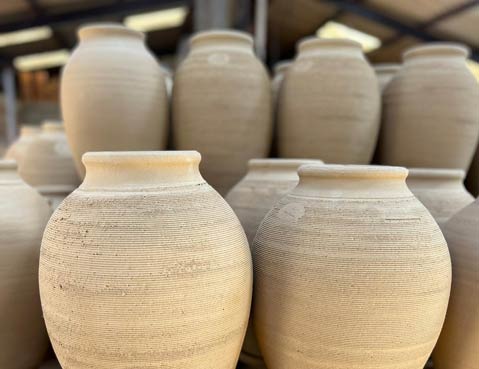
Most of these are so-called "washed" pastas that are soaked in baths and then filtered.
This process has the advantage of producing an inexpensive raw material that is quick to produce and easy to process.
Due to the filtration of impurities, these "washed" clays retain little or no residual clay particles, resulting in a compact clay with little air in the natural micro-veins and reduced porosity.
To compensate for this lack of water flow, it will be necessary to use jars with thin walls, making them more fragile and susceptible to impacts; otherwise, they would be too watertight, but also more prone to micro-cracks.
Conversely, clays made with dry-ground clays will produce a mixture with a natural grain, allowing for dense and regular micro-veining, which will give excellent porosity and structure to the ceramic, regardless of its thickness.
The dry-crushed earth technique requires more equipment and much more preparation time.
Depending on the desired production quality, the clay, after kneading (mixing of clay and water) and before extrusion (making of clay loaves before throwing), can be left to rest for several days or weeks depending on the climatic conditions of the time and the calendar.
This so-called "decay" phase – (or resting phase in pottery terminology) – allows for additional fermentation, ensuring perfect homogeneity for throwing and drying, resistance after firing, and finally, consistent porosity.
It is a crucial step that lasts a minimum of 15 days for the production of high-quality ceramics.
The creation of a clay body using dry-ground clays and long resting times results in a very high-quality raw material, but it is more expensive and takes longer to produce.
Furthermore, it is less malleable than "washed clays," which necessitates longer throwing times when making ceramics.
Dry-ground clay clays also allow for the creation of more durable Ollas, as they are thicker and larger due to their structural qualities.
They also help prevent the risk of micro-cracking during drying, firing, and post-firing.
Once the ceramics are shaped, they must be left to dry for a long time at room temperature, the duration of which is adjusted according to weather conditions, the size, and the weight of the pieces being dried.
This allows the ceramics to dry gently, without stressing them, thus preserving the homogeneity of their internal structure.
This simple, but essential operation requires the necessary time because it contributes to the mechanical resistance of the ceramics and prevents them from cracking and micro-cracks.
Drying, carried out in a sheltered spot away from wind and direct sunlight, allows most of the water to evaporate.
The drying speed is primarily due not to the temperature, but to two (almost) independent factors:
- Air humidity level:
Indeed, in the tropics with a humidity level of 90%, your rooms will dry with difficulty, if at all, even with a temperature of 45°C in the shade…. - Gas exchange:
Air renewal will dry the rooms quickly under dry air.
This phenomenon can cause deformation of the parts, or even cracking of the part if it does not dry uniformly and/or too quickly.
Rapid drying is in any case to be avoided, especially for the production of irrigation jars.
Otherwise, by reducing drying times, we increase the risks of visible cracking (bursting) and not directly visible cracking (microcrack).
This last case will impact the functioning of the jar, which will leak excessively and ultimately have a negative effect on the quality (*) of the soil. (*) See next section Microcracks.
However, for lower-quality productions or rushed jobs, there's the option of drying… -> If you're behind schedule with an order and/or there's too much ambient humidity, there's a solution. Preheating the objects in a kiln removes surface moisture before the actual firing.
This last technique involves placing the parts in an oven at a temperature below 100°C! Generally, 80°C is used for… the time it takes for the parts to finally dry.
This can last from 3 to 12 hours or even longer… (this isn't exactly environmentally friendly…).
As the oven heats up, the air inside expands, creating a slight overpressure.
This expansion forces out some of the heated air and draws in cooler air through the oven's openings (vents, cracks, doors, etc.).
Even in an electric oven, some gas exchange occurs between the inside and outside.
This drying process will result in a slight shrinkage of 2 to 8%. This is due to the evaporation of water, which turns into a gas, causing the molecules to move closer together.
Microcracks are the result of a structural defect most often caused by the following steps:
- Preparation of unsuitable shaping dough.
- Drying and cooking times too short.
- Temperatures too high during drying.
- Cooking management.
Any cracks or chips, whether large or small, visible after firing render the ceramic unusable. It cannot be sold as is. At best, the ceramic will be finely ground to make grog for potters who need this material for other collections.
More difficult to detect are ceramics that haven't cracked upon exiting the kiln, but which have micro-fissures. In the case of production for irrigation ceramics, this will have a detrimental impact on the areas to be irrigated.
Indeed, a micro-cracked jar will leak much more than normal. Generally, the water's autonomy and irrigation area are reduced by half, or even more.
It will release too much water in the same spot, continuously.
This situation is worse than overly dry soil, because the repeated excess water will compact the soil, reducing or stopping bacterial activity.
This activity is essential for the microbial and biological life of the soil, resulting in cool, aerated soils conducive to plant growth.
To avoid this difficult-to-detect defect, each batch must be checked by verifying the porosity of the jars.
The final stage in the manufacturing process of irrigation jars, the duration, the different temperature stages and the maximum firing temperature reached, vary greatly from one factory to another and depend on the previous stages.
During cooking, voids will be created by the evaporation of water and carbonaceous elements, which represent approximately 20% of the initial volume (This does not create 20% shrinkage).
Modifying clay through firing allows it to develop new properties:
- Mechanical and thermal resistance
- Low or high porosity
- Thermal conductivity
- Translucency sometimes
Depending on the maximum temperature reached, the transformations of the paste and the products obtained vary (terracotta, earthenware, stoneware, porcelain).
Changes in structure during temperature changes.
- Up to 200°C, the surface water is drained away (pre-heating)
- Organic matter oxidizes at temperatures between 200 and 450 °C and is destroyed at 700 °C
- Between 450°C and 650°C, the structure of clay materials begins to break down
- The decomposition of calcium carbonate takes place between 650°C and 800°C
- From 800 to 1100°C, there is a progressive "sanding" of the clay under the effect of the "fluxing agents"
Departure point for the different waters (from):
- Soaking water: > 0°C, during shaping
- Colloidal water: > 0°C, during manufacturing drying and firming (leather state)
- Interposition water: 23 to 100°C, during drying and the beginning of cooking (transition to the state of steam!!).
- Hygrometric water: up to 350°C, initial cooking sweating.
- Water content of kaolinite: 450°C.
- At 550°C all the water has disappeared, the clay can no longer be rehydrated!
Evolution of clays during firing:
- From 0 to 100°C, during drying: the interposed water evaporates at 100°C, transitioning to a vapor state. Risk of parts bursting.
- At temperatures between 200 and 450 °C, organic matter oxidizes, producing outgassing. The risk is the same as above.
- Quartz point: during the temperature rise, the quartz crystals arrange themselves in a different order.
At around 573°C a change in volume (of the order of 2%) occurs.
Alpha quartz transforms into beta quartz. This change is reversible upon cooling.
These volume variations can cause the part to crack if the temperature rise or fall is too rapid compared to the shaping capabilities of the clay.
It is important to understand that these are the actual temperatures at the core of the parts, and this should be taken into account even more if the parts are thick.
Some parts may have sections of varying thicknesses (thin sections compared to the rest, thin walls on a thick base, or thinner sections bonded together).
In these latter cases, if the rise is too rapid, there is a risk of cracking at the thin/thick junction because the expansion does not occur simultaneously.
Irrigation jar firing with "washed" clay
Jars made with "washed" clay are fired at a low temperature, below 1,000°C, to achieve effective porosity (approximately 18 to 20% if fired at 850/1,000°C).
Above 1,000°C, the jar's porosity would be significantly reduced, potentially rendering it completely watertight.
This clay lacks sufficient micro-veining because it is too compact due to a lack of natural grain. Combined with the shrinkage of the jar after drying and firing, this prevents it from maintaining normal porosity at high temperatures (>1,000°C).
However, it is recommended not to fire the jars at too low a temperature, otherwise they may break due to a chemical reaction when in contact with soil that is too calcareous or saline.
Production using this type of clay, due to its structure and the thinness of the resulting pieces, is prone to irregular porosity (either overly airtight or with micro-leaks) resulting from one or all of the preceding stages.
However, production is achievable within a week and therefore inexpensive, but is limited to containers with a maximum capacity of 10 liters.
If the "washed" clay jar is not sufficiently permeable, the external surface can be lightly sanded, thus increasing the hydraulic conductivity by up to 30%.
The pottery must not be glazed under any circumstances.
Firing of irrigation jars using "dry-ground" paste
Conversely, "dry-milled" pasta possesses a significant and regular micro-veining due to the high density of its natural grain and can be fired at temperatures exceeding 1,050/1,100°C while maintaining excellent porosity, provided the manufacturing process is followed correctly, although it is more complex and time-consuming.
This allows for the production of large-capacity jars (>35 liters) with high structural strength and resistance to frost.